
1944-1953


Centenary of the Declaration of the Báb
On the evening of May 22, 1944, Bahá'ís around the world celebrated the dawn of the Bahá'í Faith. Exactly one hundred years earlier, in Shíráz, Iran, at two hours and eleven minutes after sunset, a young Man named Siyyid ‘Alí-Muhammad announced that He was a Manifestation of God. He became known as the Báb, meaning “the Gate.” His Mission was to prepare the world for another Manifestation to follow Him, the Promised One of all religions—Bahá’u’lláh.

In honor of the Báb’s sacred Declaration, the American Bahá'ís planned commemorative activities over a six-day period. In spite of the challenges presented by World War II, Bahá'ís from across the United States and Canada, as well as several Central and South American countries, converged upon Wilmette. Each day featured special presentations and events at the Temple, with talks by many Bahá'ís, as well as distinguished guests who were not Bahá'ís.

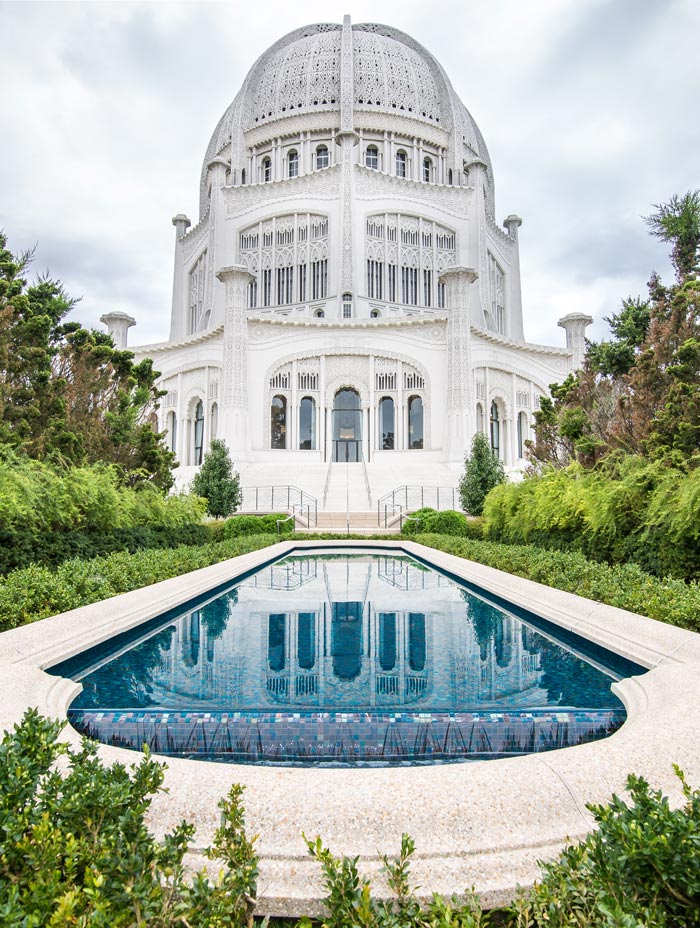
To prepare the Temple for the event, some landscaping had been completed and the parking area expanded. Foundation Hall was thoroughly renovated. One thousand chairs were set up in the auditorium, along with temporary loudspeakers. Perhaps most striking was the fact that the building was floodlit at night for the first time using temporary equipment, as described by one observer:


The equipment used was only roughly adapted to its purpose, yet the effect was simply astounding. A feeling of unreality, of a building that was not of the earth, but which seemed to be a vision, overpowered every one. It arrested the step of every person, no one could walk past without stopping again and again to gaze at it. The entire form glowed as though made of luminous material and there was a feeling of vibration that seemed to make it alive.


At 9:40 PM on May 22, the Bahá'ís gathered in the auditorium to dedicate the House of Worship and remember the Báb’s momentous Declaration. Writer Marzieh Gail described her experience:


. . . we walked up the white path in the darkness, up the steps through one of the nine great portals. The vast space beneath the Dome was packed with Bahá'ís. I wished the Guardian could have been there to see them; to see all these souls across the earth, who have grown out of the words that the Báb spoke in Shíráz a hundred years ago tonight.

. . . I looked behind me and saw faces pressed against the glasspeople on the steps outside, peering in and wondering. I can’t explain how happy the people inside were; I had never felt an audience like this.


After a devotional program, the Bahá'ís viewed a portrait of the Báb sent to America by Shoghi Effendi as a gift for the occasion. This experience may have been profoundly moving, as images of the Báb and Bahá’u’lláh are treated with great reverence and only viewed on very special occasions.

Numerous newspaper stories and radio broadcasts kept the public informed of the events throughout the six-day celebration. A photograph of the floodlit Temple was featured on the cover of the publication Wilmette Life. On May 25, a centenary banquet commemorating the fiftieth anniversary of the establishment of the Bahá'í Faith in the West was held at the Grand Ballroom of the Stevens Hotel to conclude the festivities. In addition to the banquet dinner, the program included an address by a guest speaker and presentations about the Bahá'í Faith; the evening closed with Bahá'ís from around the world sharing their impressions of the centenary in a live broadcast via Chicago radio station WCFL.


Alfred P. Shaw

The National Spiritual Assembly faced a significant challenge in completing the interior of the House of Worship, in that only small working drawings had been created by the Temple architect, Louis Bourgeois, before his death in 1930. Also, some features of his design were elaborate and expensive, including the creation of eight small rooms with stained-glass ceilings around the perimeter of the auditorium and the installation of stained glass in the dome. Shoghi Effendi authorized the National Spiritual Assembly to simplify Mr. Bourgeois’ design.

The National Spiritual Assembly enlisted the help of Allen McDaniel, who had previously served on the Assembly for 21 years and whose engineering consulting firm, The Research Service, had assisted with the Temple construction over the years. Mr. McDaniel, working with two architectural draftsmen who had experience with the Earley Studio, created sketches for the interior design. Chicago architect Earl H. Reed was invited to prepare an alternative design. Dr. Paul E. Sabine, an acoustical expert, was also consulted in regard to both efforts. When the two plans were submitted to Shoghi Effendi, he directed that elements of Mr. Reed’s design should be incorporated into Mr. McDaniel’s. Mr. McDaniel prepared new drawings following these recommendations.

From these drawings, an architect was needed to prepare detailed architectural and engineering plans. The National Spiritual Assembly chose Alfred P. Shaw, who had designed the Chicago Merchandise Mart, the Field Building, and the interior of the Chicago Museum of Science and Industry. However, it was then decided that Mr. Shaw should have the chance to create his own interpretation of Mr. Bourgeois’ vision. Mr. Shaw created a design that integrated recent advancements in architecture as well as elements of the Art Deco style. Shoghi Effendi approved Mr. Shaw’s design in May 1948, and work on the Temple interior soon began.

In commenting on his involvement with the Temple, Mr. Shaw shared the following remarks at the 1951 Bahá'í annual convention:


. . . it is not an easy or natural task to take an achievement such as Louis Bourgeois’s great structure here and complete it. The proper solution demands a homogeneity with another man’s inspiration and his aesthetics. . . .

By the nature of the instructions from the Head of your Faith, there were certain aspects of the Bourgeois design which were to be adhered to. There was also the natural architectural need of unity and there were certain details and aesthetics also which, after laying aside a design for some years, even the original architect would very likely have wanted to change. There was also, if I may be permitted to say so, the necessity of the present architect believing in the merit of his own achievement. . . .

The resulting open lace-like pattern in stone, organized into nine bays horizontally and four general vertical units and woven into one design has taken some of the character of the exterior and brought about a unified quality on the interior. This quality—although, personally, I have not done it for that reason alone—represents, I discover in talking with the members of the Committee, the unity of the beliefs which your Faith symbolizes. . . .

We, as the architects of the interior, hope and believe that the great purpose of this Temple will be more successfully fulfilled because of this completion of the interior. We also hope that it will be a continuing inspiration to all of you here in America and to all of your Faith.


Temple Gardens
The National Spiritual Assembly reviewed several plans for the nearly five acres of grounds before deciding on the design presented by Hilbert E. Dahl of Frankfort, Kentucky. Each design incorporated ‘Abdu’l-Bahá’s instructions that nine gardens, each with a fountain, be separated by nine walkways that led to a circular path surrounding the Temple.

Mr. Dahl had long been studying the challenges presented by the House of Worship gardens. He had served as a guide at the Temple in the 1930s, while living in Illinois, and had developed his first plan for the gardens in 1938. Mr. Dahl commented on his philosophy for the task:


Its setting, as with the jewel, must emphasize the attractiveness of the structure and, while reflecting lines and embellishments and the spirit of the Temple, must not, in itself, be given ornamental character which will compete with the building. . . .

The gardens are arranged and planted with simple dignity, restrained in treatment but with a touch of color and softness of texture which will give them a gardenesque feeling of peaceful and quiet loveliness.


The nine gardens were similar in nature, each separated by Chinese juniper trees. Each featured two crescent-shaped beds, where a variety of flowers bloomed, and a nineteen-foot circular pool. The George A. Fuller Company was contracted to complete the landscaping work.


Public Dedication of the Temple

The 1953 American Jubilee Celebration was part of a series of events held around the world to commemorate the centenary of the birth of Bahá’u’lláh’s Mission. In 1852, while imprisoned in the notorious Síyáh-Chál, or Black Pit, in Tehran, Iran, Bahá’u’lláh had experienced a glorious divine vision. Compared by Shoghi Effendi to Moses’ experience of the Burning Bush, Jesus’ vision of the Holy Spirit, and Muhammad’s visitation by the Angel Gabriel, Bahá’u’lláh’s vision marked the initiation of His Revelation. The sacred occasion was marked by a Holy Year that commenced in October 1952.

The American Jubilee included four large public meetings. In addition to Bahá'í speakers, guest presenters included Dr. Paul Hutchinson, editor of Christian Century; Dr. Charles H. Wesley, president of Central State College at Wilberforce, Ohio; and Mr. Norman Cousins, president of the United World Federalists and editor of the Saturday Review of Literature.

On May 1, Bahá'ís gathered at the Temple for a private ceremony honoring ‘Abdu’l-Bahá’s dedication of the site on the same day in 1912. Bahá'í prayers and Writings, including the words of ‘Abdu’l-Bahá on that historic occasion, made up the program.

On the following day, May 2, thousands gathered for the public dedication of the Temple. The crowds thronged the steps and walkway, then spilled onto the sidewalk. Members of the press were seated in the gallery, above the more than eleven hundred participants in the main auditorium. Large bouquets of red roses stood near the lectern. Present were thirteen of the eighteen living Hands of the Cause of God, as well as nearly all of the Bahá'ís still living who had participated in 1912 dedication ceremony. One of these distinguished individuals was Corinne True, the Mother of the Temple, now ninety-one years old. She had been honored by Shoghi Effendi a year earlier with the title of Hand of the Cause of God, a distinction conferred upon a small number of outstanding Bahá'ís. Her daughter, Edna, remembered Mrs. True’s reaction:

I have never seen her so affected by anything as she was by the fact that she was going to the dedication. As she approached the Temple everyone stopped her wanting to speak to her, but she couldn’t. She did not weep, but she could not speak. She could hardly raise her head. It was a tremendously moving moment. It was like carrying a load for a very long time, and then, suddenly, the load was lifted. At that moment it was reality.


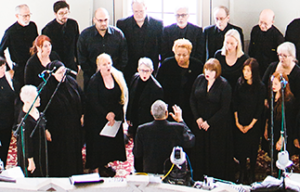
A choir from Northwestern University provided uplifting music. Then Amatu’l-Bahá Rúhíyyih Khánum shared Shoghi Effendi’s message with those present:

On behalf of the Guardian of the Faith of Bahá’u’lláh, I have the great honor of dedicating this first Mashriqu’l-Adhkár of the Western World to public worship.

Initiated fifty years ago, its foundation stone laid by ‘Abdu’l-Bahá, the son of the Founder of the Faith, raised by contributions from its followers all over the world, reared in the vicinity of the first Bahá’í center established in the West, this House of Worship, now opening wide its doors to peoples of all creeds, of all races, of all nations and of all classes, is dedicated to the three fundamental verities animating and underlying the Bahá’í Faith—the Unity of God, the Unity of His Prophets, the Unity of Mankind.

I greet and welcome you on behalf of the Guardian of our Faith within these walls, and invite you to share with us the words recorded in the Sacred Scriptures which we believe to be repositories of the eternal and fundamental truths revealed by God in various ages, for the guidance and salvation of all mankind.


The devotional program included sacred words from the Bahá'í Writings, the Bible, and the Qur’án. Some Bahá'í prayers were chanted in Persian and Arabic. Except for Rúhíyyih Khánum’s opening dedication, the entire program was presented three times to a full auditorium. Many more had to be turned away.

William Sears, a radio and television performer who was later named a Hand of the Cause of God, shared his impressions of the ceremony:


It is impossible to report upon a prayer or a meditation. They exist in a realm of values independent of words. To convey the exaltation that animated Bahá'ís on this never-to-be-repeated occasion is equally beyond the power of expression. To each worshiper, the moment was a personal one, associated with the heart and spirit. . . .

Every moment inside that dome of exquisite beauty and majesty, on the day of its dedication, was enriched by memories of the love and sacrifice that had raised this jewel of God. . . .

The House of Worship does not belong to the Bahá’ís alone; it belongs to humanity. It is a gift from the Bahá’ís; a house of prayer with doors thrown wide open to men and women of all races and religions. Inside its doors there is no infidel or pagan; all are children of one God. All may turn their hearts to Him and know that they are brothers.


Another event with special significance for the Bahá'ís took place on May 3. Gathering again at the Temple, more than twenty-three hundred Bahá'ís had the opportunity to view the portrait of the Báb that Shoghi Effendi had sent for the 1944 centenary commemoration, as well as his priceless gift for the Jubilee—a colored portrait of Bahá’u’lláh as a young Man. Rúhíyyih Khánum anointed each person with attar of rose as they moved into the Temple for the honor of viewing these sacred gifts.

The significance of the Temple dedication was not lost on the public at large. The National Spiritual Assembly received congratulatory messages from many individuals, including Justice William O. Douglas of the Supreme Court of the United States; Abba Eban, ambassador of Israel to the United States; author Dr. Marcus Bach of the University of Iowa; Thurgood Marshall, director and counsel of the NAACP’s Legal Defense and Education Fund and later a Supreme Court justice; and Roy Wilkins, executive director of the NAACP.

The media provided extensive coverage of the dedication and Jubilee. Over five hundred newspapers around the country published articles. Booklets featuring a cover photo of the Temple and an article on its history were distributed by three railroads serving Chicago. Universal International included the dedication in its Universal Newsreel. A series of thirteen radio programs was broadcast in many cities and even reached Europe, the Near East, and Latin America via the World Wide Broadcasting Corporation. Numerous radio and television stations across the United States also covered the dedication.


Amatu’l-Bahá Rúhíyyih Khánum
Amatu’l-Bahá Rúhíyyih Khánum, also known as Madame Ruhiyyih Rabbani, was a uniquely prominent woman in the Bahá'í Faith. As the widow of Shoghi Effendi, she was the final link to the family of ‘Abdu’l-Bahá until her death in 2000. She also distinguished herself through her intrepid and heroic service to the Faith in many capacities.

She was born Mary Maxwell in New York City in 1910. Her parents, May and William Sutherland Maxwell, were distinguished Bahá'ís. Many years later, her father served as the architect of the Shrine of the Báb.

Mary Maxwell began serving the Bahá'í Faith in her youth. She gave her first talk about the Bahá'í Faith at the age of fifteen. She also participated in Bahá'í school and on youth committees. Along with several other Bahá'ís, Mary visited the Temple site in 1933, when the first panels of exterior ornamentation arrived, and she read a prayer to honor the occasion.

Mary visited the Holy Land on pilgrimage three times. On her third visit in 1937, at age twenty-seven, she married Shoghi Effendi. She then became known as Rúhíyyih (Spirit) Khánum. Later Shoghi Effendi gave her the title Amatu’l-Bahá, meaning “Handmaiden of Bahá.”

Rúhíyyih Khánum worked by her husband’s side for many years as his secretary, proofreader, and, in his words, “my tireless collaborator in the arduous tasks I shoulder.” She also represented him at key events. In 1952, he honored her with the title of Hand of the Cause of God. After Shoghi Effendi’s untimely death in 1956, Rúhíyyih Khánum, although grieved, continued to serve the Bahá'í Faith with incredible devotion and zeal.

Rúhíyyih Khánum was determined to share the Bahá'í message of love and unity with the world. She visited about 185 countries and territories, encouraging Bahá'í communities, meeting with world leaders and ordinary citizens, and representing the Bahá'í Faith on important occasions. She also wrote several books, including The Priceless Pearl, a biography and intimate portrait of her husband and his work as the Guardian of the Bahá'í Faith.

Amatu’l-Bahá Rúhíyyih Khánum passed away on January 19, 2000. The Universal House of Justice communicated the event to the Bahá'ís of the world, noting, “Down the centuries to come, the followers of Bahá’u’lláh will contemplate with wonder and gratitude the quality of the services—ardent, indomitable, resourceful—that she brought to the protection and promotion of the Cause.” She was buried in Haifa, Israel, near the House of ‘Abdu’l-Bahá, and a monument was later erected at her resting place.